In all cases, HR must review the reason for the termination and ensure the decision will be defensible in court should the former employee decide to file a lawsuit.
It is almost always best to focus on objective reasons rather than resorting to subjective assessments. Ensure that all terminations are based on solid business reasons. And be sure to carefully document why you decided to terminate, even if you don’t share the rationale with the employee.
Recent case: The EEOC has settled a case involving the termination of the only Black project manager working for Sureste Development. At first, the real estate company said the manager performed well. However, he was terminated less than a year after he began working at Sureste. The stated reason was that he was “lazy” and not a good fit for the company’s “culture.”
He filed a complaint with the EEOC claiming he had been assigned more work than the company’s other project managers who were not Black. The EEOC sued on his behalf.
Then Sureste changed its story, explaining it had terminated the man because it had eliminated his position. But during discovery, it turned out that Sureste’s records showed it had promoted a significantly less-qualified white employee to the same position the Black project manager held.
Instead of taking its chances in court, Sureste agreed to settle the case. The fired project manager will receive $70,000, and the company must train all its supervisors, managers and employees on discrimination.
Note: Shifting reasons for a termination hardly ever works out for employers. The more your explanation “evolves,” the less credible your company looks.
Advice: HR should monitor what happens after a worker is discharged. If someone was fired because his or her position was eliminated, make sure no one is hired to fill that position soon after.
Want more content like this? HR Employment Law Advisor members can log on to the website each morning and receive multiple new pieces of content, such as stories like this one. Click here to learn more about a membership and how the service can help ease some of your employment law burden.
States are emerging as prime sources of new employment-related laws. Congress didn’t pass much in the way of employment laws at the federal level this year. The Supreme Court largely steered clear of issuing opinions on employment-law questions (although one case did address sex discrimination).
That has left states to pick up the slack, subjecting employers to a dizzying array of new labor and employment laws. Here is a sampling of new laws scheduled to go into effect on Jan. 1, 2025, or soon after.
Background checks
Child labor
Several states have tightened their child-labor laws. Others loosened them.
CROWN Act
Domestic violence leave
Paid sick leave
Pay transparency
Several states require starting salaries to be posted with job ads.
Workplace safety
Final note: This list does not cover every new law. Check with your state department of labor for the latest minimum-wage increases and any other new laws or regulations effective in 2025.
Want more content like this? HR Employment Law Advisor members can log on to the website each morning and receive multiple new pieces of content, such as stories like this one. Click here to learn more about a membership and how the service can help ease some of your employment law burden.
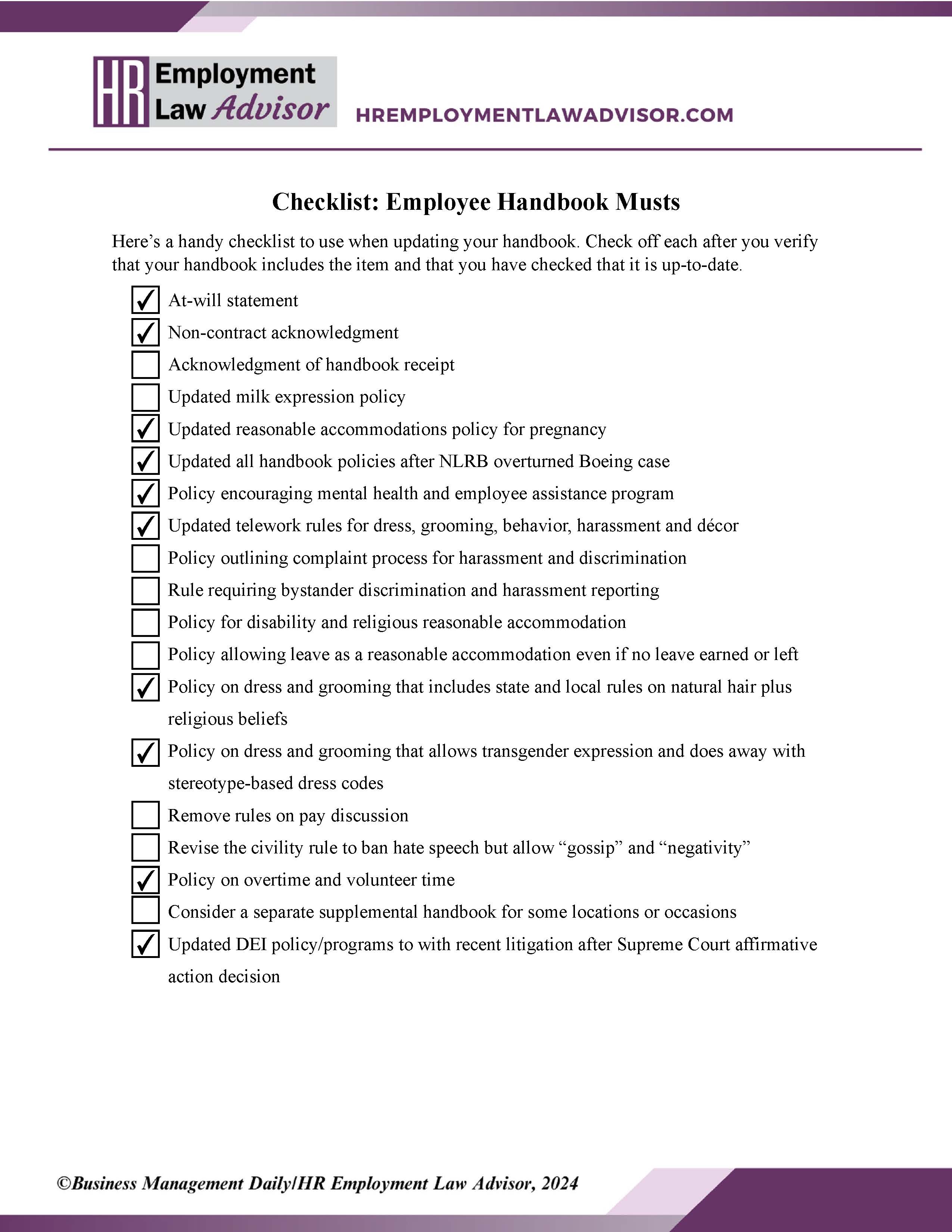
Here’s a handy checklist to use when updating your handbook. Check off each after you verify that your handbook includes the item and that you have checked that it is up-to-date.
Download Employee Handbook Musts now